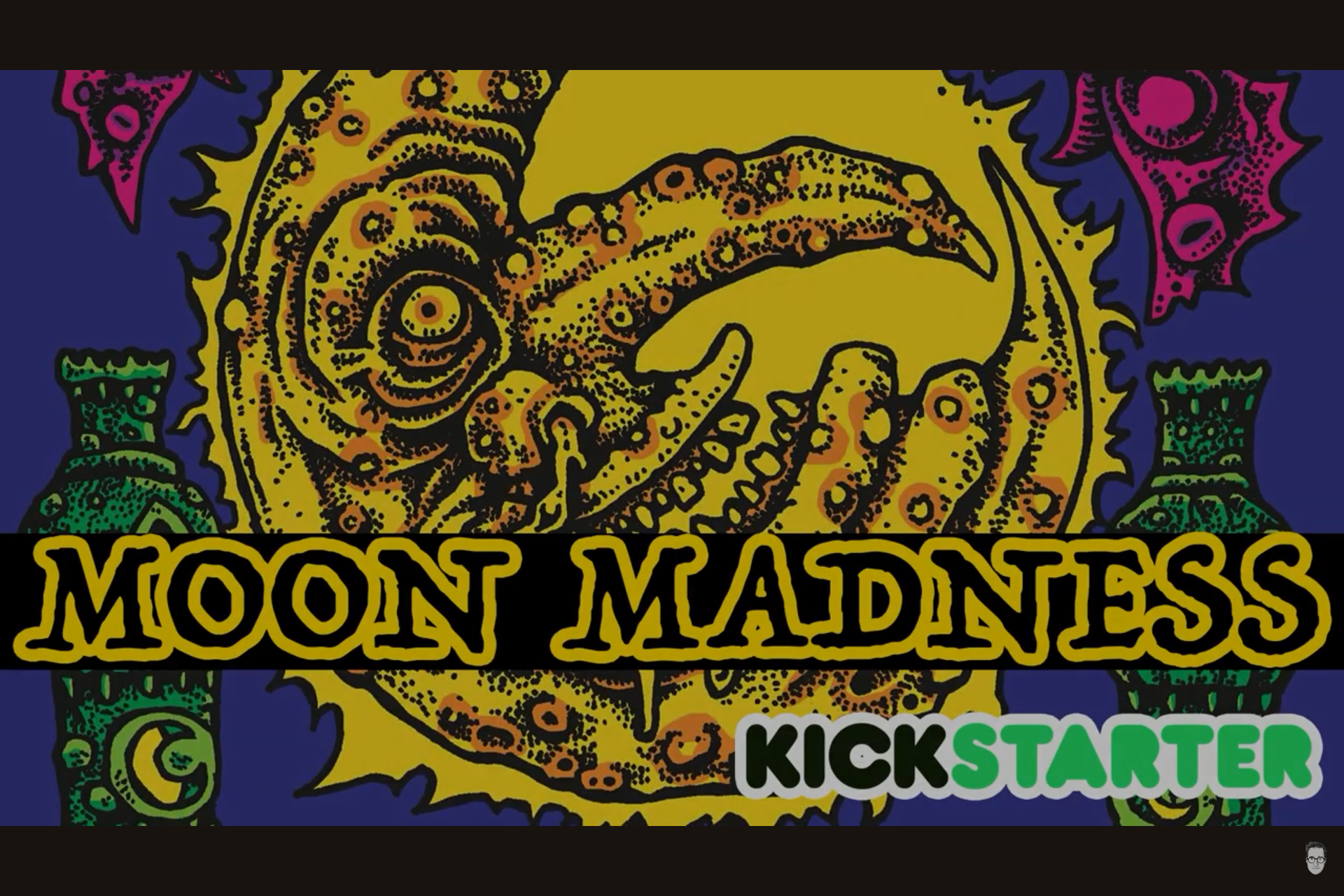
A Travelogue from the Würstreich
A two-handed solo campaign through Dungeon Degenerates: Moon Madness, playing as the Alley Cat and the Fugitive Fop. We are both of them. We have always been both of them.
We reach Stone Circle just after dark and the air tastes like something that has been waiting a long time to be breathed.
“Gray,” he says.
“It’s a magical site.”
“I know what it is. I’m observing that it’s gray. Everything here is gray.”
“Everything is gray. That’s how you know it’s real.”
He doesn’t argue. This is progress. Three weeks ago he would have argued, and she would have bitten him, and the raccoon-creature would have screamed, and we would have been back where we started. We’ve learned each other since then. We’ve had to.
Who We Are and How We Got Here
She was left in the Witchwood as an infant. This is the kind of sentence that sounds like the beginning of a story, and it is, but it is also just a thing that happened. The forest raised her in the way forests raise things — without language for it, without sentimentality, according to the rules of what eats and what is eaten. She spent ten years there before she understood there was anywhere else to be. When she came to Brüttelburg she already knew how to survive. She didn’t know how to want things. She’s been learning.

Her crimes are listed as Taint of Corruption and Vagrancy. She wears a Safety Collar against her will and carries a Begging Bowl and disguises herself as an urchin, which she also genuinely is. The Lycanthropy is not a disguise. The Mark of the Beast was on her when they found her at the treeline. She carries it the way you carry something you didn’t choose and have decided to keep.
He is from the Obenstadt. The upper city. He wore beautiful things and moved in rooms full of people who loved him for exactly who he was, which is a luxury so extraordinary he didn’t know to call it that until it was revoked. His crimes are Buggery and Lewd Conduct, recorded by the Würstreich’s courts with the same flat bureaucratic tone used for theft and arson. He was expelled from the polite society of Brüttelburg and the expulsion was not polite. He carries a Pistol Knife and a Fluffy Familiar, which is a raccoon-adjacent creature of suspicious intelligence and excellent judgment. He is, by the standards of the Würstreich, wildly unprepared for everything that is happening to him.
He is also the funniest person she has ever met, which she would rather die than admit.
The Escape (Brüttelburg, Three Weeks Prior)
Here is what happened at the gate.
The guards were three. He was running in the wrong direction, which was toward them, because he had not yet recalibrated for the specific texture of genuine danger versus social danger. The raccoon-creature had fallen from his jacket pocket in the scramble and was sitting in the middle of the road looking betrayed.
She went back for it.
“You went back,” he said, afterward, when they were clear of the walls and he had stopped shaking.
“It was frightened.”
“I know. I just — you didn’t have to.”
“I know I didn’t have to.”
He looked at her for a long moment. The raccoon-creature had transferred itself to her shoulder and was examining her ear.
“I’m going to be quite loyal to you,” he said. “Specifically. I want you to know that.”
“You’re already quite loyal.”
“I’m going to be quite loyal,” he said, which is a distinction she has come to understand is meaningful for him. Not the fact of a thing but the degree of it. He was raised on degrees.
She let him keep the raccoon-creature’s weight on his side of the night and didn’t say anything else and he understood that as the acceptance it was.
Stone Circle
Starydnoko is a Gütter farmer. He wears folk clothes and lives in a modest hut and has a goat named Uparty, who examines us both with the total unimpressed intelligence of goats everywhere.
“She likes you,” she tells him.
“How do you know?”
“She’s not running.”
He reaches out very slowly and Uparty permits it. This will matter later. Everything in the Würstreich matters later, if you pay attention.
Starydnoko wants to bring down the Moon. Literally. He wants to draw it toward the earth through pagan rite and ancestral will and the combined grief of generations of Gütter who have been on the receiving end of civilization’s idea of progress. The Gütter folk run guerilla disruptions. They damage the empire at its weak points. Starydnoko has concluded that the Moon itself, drawn down, is the key.
“That’s insane,” he says.
“Yes.”
“You’re agreeing with him.”
“I’m Wild,” she says. “I’m always agreeing with him.”
She is. The Alley Cat is Wild — that’s the faction, the bloodline, the thing that puts us on this side of the mission and not the other. We are Gütter Sympathizers before we know we are, because that’s what it means to carry the Mark of the Beast and the Taint of Corruption and live in the gutter of the empire’s city pretending to be smaller than you are. The Gütter have been pretending to be smaller than they are for two hundred years. We understand each other.
He looks at Starydnoko. He looks at us. He looks at Uparty.
“Right,” he says. “When do we start?”
North Bridge, Holy Order, Dusk Falls
What the middle of a campaign feels like: movement and encounter and the steady accumulation of context. North Bridge in the rain, where the tolls are not paid in coin. The Holy Order doing something we are asked not to describe. Dusk Falls, which is exactly what it sounds like — a place where something heavy has landed and hasn’t left.
The Nackt Drek are deployed against the Gütter in the lowlands, which is an imperial problem we are now personally invested in. They are the empire’s teeth in this particular mouth. Driving them mad is the objective and it turns out she is useful here in ways that the Würstreich cannot categorize.
The problem is a locked building in a contested district. Three guards outside. The kind of structure that has been bureaucratically decided to be inaccessible.
She goes quiet in a particular way.
“You’re doing it again. You go very still and your eyes change.”
“My eyes don’t change.”
“Your eyes absolutely change. They go — amber. Like you’re calculating something.”
The Safety Collar is a magic item. What it does is constrain. What it constrains is the Lycanthropy, which has its own agenda and which she has negotiated to a détente over the course of ten years in the forest. The détente has terms. The terms include: three wounds and the Luck condition triggers and the claws do what they were designed to do.
She takes the wounds deliberately. This is a choice.

“That looks —” he starts.
“Don’t.”
“I was going to say impressive.”
“Don’t say that either.”
What opens the building is not a key. What opens it is what she is. Amber-eyed and clawed and carrying the forest in her bloodstream. The guards assess the situation and reach a professional conclusion about risk tolerance.
We go inside.
He never mentions the wounds again. He does, when she’s not watching, check on them. This is also a choice.
Later, at a Gütter settlement near Dusk Falls, there’s a checkpoint. Würstreich minor officials wanting documents, wanting to know our business, performing the authority of an empire that has been performing authority so long it has forgotten what it was originally for.
He steps forward.
“Fluff,” she says quietly.
“I know.”

He produces the raccoon-creature, which climbs to his shoulder with practiced elegance, and he straightens his ostentatious attire, which has been through significant adventures and still looks, somehow, expensive, and he gives the officials the smile of someone who grew up in the Obenstadt and whose social utility was calibrated before he could walk.
“We’re naturalists,” he says pleasantly. “Conducting a survey of the eastern provinces for the Academy. This is our specimen.” He gestures to the raccoon-creature, who has the dignity to appear to be examining a document. “I would show you our letters of introduction but they’re with our equipment, which is being brought by wagon. I’m sure you understand.”
There are no wagons. There is no Academy. He has letters of introduction for nothing.
They let us through.
“You’re outrageous,” she tells him, once they’re past.
“I’m practical,” he says. “Same thing, different context.”
Named
When Bad Moon Rising ends in our favor — the Nackt Drek driven mad, the imperial foothold weakened, Starydnoko looking at us from his hut with the expression of someone who didn’t expect to survive but did — we are named Gütter Sympathizers.
This is now a fact about us.
“Is that bad?” he asks.
“It’s accurate.”
“That’s not what I asked.”
“It means we chose. The Würstreich keeps score. Now it knows which side of the score we’re on.”
He considers this. His familiar chitters. Uparty has wandered over from somewhere and is standing near us in a way that feels like solidarity.
“Well,” he says, “I was expelled for worse.”
Moongazer
The Black Tree is really black. The kind of black that isn’t an absence of color but a presence of something else. We stand at its base and the information we need is in there somewhere — in the wood, in the dark between the roots — and she puts her hand on the bark and the bark knows her back.
“What does it feel like?” he asks.
“Like the Witchwood. But older.”
“How can you tell?”
“The Witchwood is afraid of things. This isn’t afraid of anything.”
The Temple of Madness holds certain High Alchemists of Brüttelburg who have been researching the Moon’s accessibility for professional reasons we are asked not to examine too closely. They know things. We have Gütter Sympathizer status on our record and it turns out this is exactly the right credential for the people we need to see. The Warlocks of the Stone Circle are already friends.
Moon counters accumulate. The Phase Track advances. The Full Moon is close.
At the Ghostgate there is a threshold you cross by becoming willing to cross it, which sounds mystical and is, in practice, exactly as mystical as it sounds. She crosses it easily. He hesitates.
“I can hear something on the other side,” he says.
“Yes.”
“What is it?”
“Something that knows we’re coming.”
“That’s not reassuring.”
“It’s not supposed to be reassuring,” she says. “It’s supposed to be true.”
He crosses the threshold. The raccoon-creature went first, which settled the question, because the raccoon-creature has never been wrong about anything.
Here is something I believe about chaos magic: the universe is patterned meaning all the way down, and the patterns respond to attention. This is not a metaphysical claim so much as an observation about how things work in practice — the card you draw when you need it, the coincidence that arrives with the specific weight of an answer, the way a game’s mechanics will sometimes rhyme with your interior state in ways that cannot be explained by probability alone.
The Würstreich understands this. It is built into the game’s architecture — the Phase Track, the Astral counter, the way the Moon Phase affects specific skills and items as if the Moon has opinions. Starydnoko understands this. The Gütter have always understood this. You cannot live that close to the land, for that many generations, without developing a sophisticated theology of attention.
This is also why the solution, when it comes, is cheese.

The Cheese
A Gütter farmer sells it to us. It is magical. It is made from the milk of animals grazed on Witchwood-adjacent land under specific lunar conditions. The Full Moon has been found. The conditions are met. We are told, by the farmer and by the Warlocks and by something in the grain of the Black Tree that she picked up and has been carrying for days, that this is how you go to the Moon.
You eat the cheese. You dream yourself there.
“I want you to know,” he says, holding his portion, “that I have eaten some extremely good cheese. From the Obenstadt, from the southern provinces, from a very peculiar man in the Highlands who kept bees. This is not the best cheese I’ve had.”
“Does that matter?”
He looks at the cheese. He looks at us.
“No,” he says. “Not even slightly.”
We eat the cheese. We go to sleep.
When we wake up, we are somewhere else entirely.
Moon Side
The Astral Status Condition sits next to our character cards now, and everything we acquire up here goes beneath it. The game is explicit: what you find on the Moon is not yours until you bring it home. You are guests. Act accordingly.
“It’s not what I expected,” he says.
“What did you expect?”
“I don’t know. Something — emptier. It’s not empty.”
It is not empty.
The Moon is a place with a politics and an economy and a class structure and several ongoing grievances, which makes sense when you think about how long it’s been looking down at the Würstreich. Some of that was going to stick. We are Gütter Sympathizers and we are now on a world run by a cult of elite druggies over a feral enslaved class that outnumbers them five to one, and we know this story, and we know which side of it we’re on.
We adjust.
Luneberg
The second largest city on the light side of the Moon is called Luneberg and it runs on the performance of luxury. Escapist architecture. Everything designed to make you forget you have a body with needs. The Mondmenschen are at ease here in a way they aren’t anywhere else and for once that works in our favor.
He steps forward and the raccoon-creature arranges itself on his shoulder and his attire — road-worn, slightly damaged, fundamentally ostentatious — reads in Luneberg as eccentric wealth rather than fugitive aristocracy. The Fluffy Familiar is received as a collector’s piece. His bearing is received as someone who has always moved through rooms that wanted him there.
“You’re doing it again,” she tells him. “Being comfortable.”
“I’m not entirely comfortable. I’m performing comfortable.”
“What’s the difference?”
He thinks about this.
“The Obenstadt,” he says, finally. “I was comfortable in the Obenstadt. I knew everyone. I knew what the rooms wanted from me and I could give it to them and they’d give it back. This is — I can see the scaffolding here. I can see that it could all come down. Maybe should come down. But it doesn’t come down, does it, if you don’t look at it directly.”
“That’s what luxury is,” she says.
“Yes.” A pause. “I knew that. I just — didn’t know it that way.”
We get through Luneberg with information we needed and favors called in from people who thought they were doing us favors. This is his skill. Not the Dilettante card, not the mechanics exactly, but the thing the Dilettante card gestures toward: the ability to move through a system without disturbing it, to take what the system offers before the system notices you’re taking.
In the Witchwood there was no system. This is what she thinks about in Luneberg. How he learned to live inside something she was never inside to begin with.
Mondheim
The largest city is underground and its ceilings are high.
This should not be as moving as it is.
Organic architecture, rounded edges, everything in the direction of something grown rather than built. The light comes from somewhere other than the sun and it is sufficient and warm. The Mondmenschen and the Mondsklave move through the same spaces here, which is either progress or theater, and we have been in the Würstreich long enough to know the difference and the difficulty of the difference.
She stops in the main hall and looks up.
“The Witchwood had ceilings like this,” she says.
“It’s a forest. It didn’t have ceilings.”
“The canopy,” she says. “When you look up and there’s — distance. Space. Room to be something large.” She pauses. “I didn’t know I’d missed it.”
He doesn’t say anything. He puts a hand on her shoulder for a moment and the Familiar makes a sound and then we keep moving.
The Four Factions
The Ka-Sen are ancient in the way very few things are actually ancient, which is to say their ancientness is in their bones, not in their manner. They regard us with the specific attention of a civilization that has seen every version of the situation we’re in. She meets that attention directly. She was raised outside the social order of the Würstreich. She has no instilled deference for the thing looking at her. They assess each other and reach a mutual non-aggression conclusion that is the closest thing to respect either of us has received on the Moon.
The Glänzende are tall and their logic is their own. We don’t try to translate it.
The Mondmenschen are a cult and their certainty is the certainty of people who have convinced themselves the ground belongs to them. We know this certainty. We are from the Würstreich.
The Mondsklave are everywhere and they outnumber the cult five to one and the tension between those facts is an ongoing event that the Moon does not resolve. We are Gütter Sympathizers. We know this math.
“Do you think it will break?” he asks, meaning the tension, meaning the five-to-one, meaning the whole structure.
“Everything breaks,” she says. “The question is when.”
“And who’s there when it does.”
“And who’s there when it does.”
Before
We are at the edge of the Lunar Lair.
We have Moon counters and Astral loot and a relationship that has been tested by the Black Tree and the Holy Order and the Ghostgate and Luneberg and the cheese. We have done things on this Moon that the Würstreich would add to our record if the Würstreich had any idea where we were.
“I want to say something,” he says.
“Then say it.”
“When we get back — when this is finished — I think we should go north. There are provinces nobody’s ever seen. Past the Ka-Sen territories there might be things that don’t want to kill us.”
“Everything wants to kill us.”
“I know. I’m saying there might be different things that want to kill us. For variety.”
She looks at him. He looks at her. The raccoon-creature has positioned itself between them in the way it does when it judges the moment to be significant.
“Okay,” she says. “North.”
He nods. She nods. We check our cards.
She’s gone quiet in the particular way. The amber-eyed way. Three wounds on the Lycanthropy card, the Luck condition live, the claws present and accounted for.

The Lunar Herald is ahead. What we know about it is that it is Weird, which in the Würstreich is not a category but a condition, and that it carries Flash and Petrify, which are abilities that exist specifically to prevent you from doing what you came here to do.
We do not know what happens next.
This is the feeling. This is exactly the feeling. The table spread out in front of us, the Moon Board, the cards face-down, the Phase Track at whatever phase it’s at, the raccoon-creature watching from the card tray with its raccoon face that says nothing and means everything.
Anything could happen.
We are here.
Dungeon Degenerates: Moon Madness is available at goblinkomegamall.com. LowLife: A Dungeon Degenerates TTRPG, the full roleplaying game expanding into the continent of Bödengärd, is currently being funded.